

Serving Canadian associations since 2001

Nonprofit Strategic Planning for Associations

Table of Contents

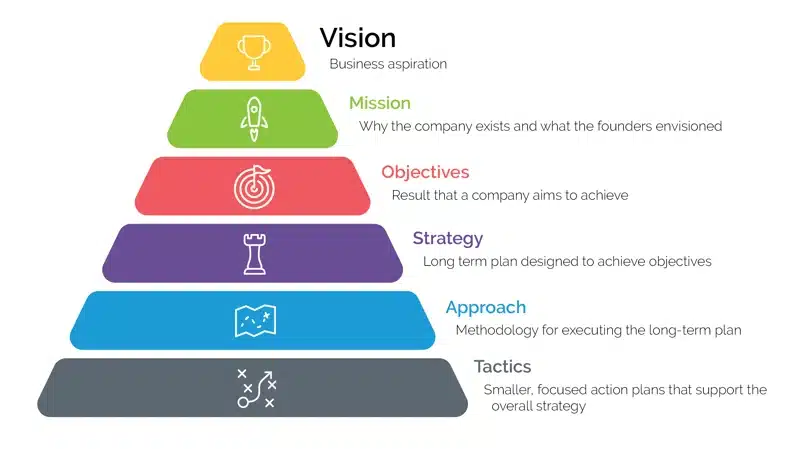
Pyramid Infographic Showing Business Planning Levels from Vision to Tactics with Color-coded Steps and Labeled Descriptions on the Right.

Introduction

If you lead a not-for-profit membership organization, you already understand the daily pressure. Board members volunteer their time while juggling full‑time jobs. Staff is doing incredible work with limited capacity. Members expect more every year. And in the middle of all that, we need to undertake strategic planning.

Strategic planning is one of the most powerful actions an association can take.
The problem is how many organizations approach it. Too often, a strategic plan becomes a polished document that’s admired for a moment… then inadvertently shelved while day‑to‑day operations take over.

At Zzeem, we’ve spent over 20 years helping membership organizations across Canada create strategic plans that actually work. Plans that unite boards, energize members, and drive real results.

Whether you’re starting from scratch or reviving a plan that never gained traction, this guide will walk you through what truly works.

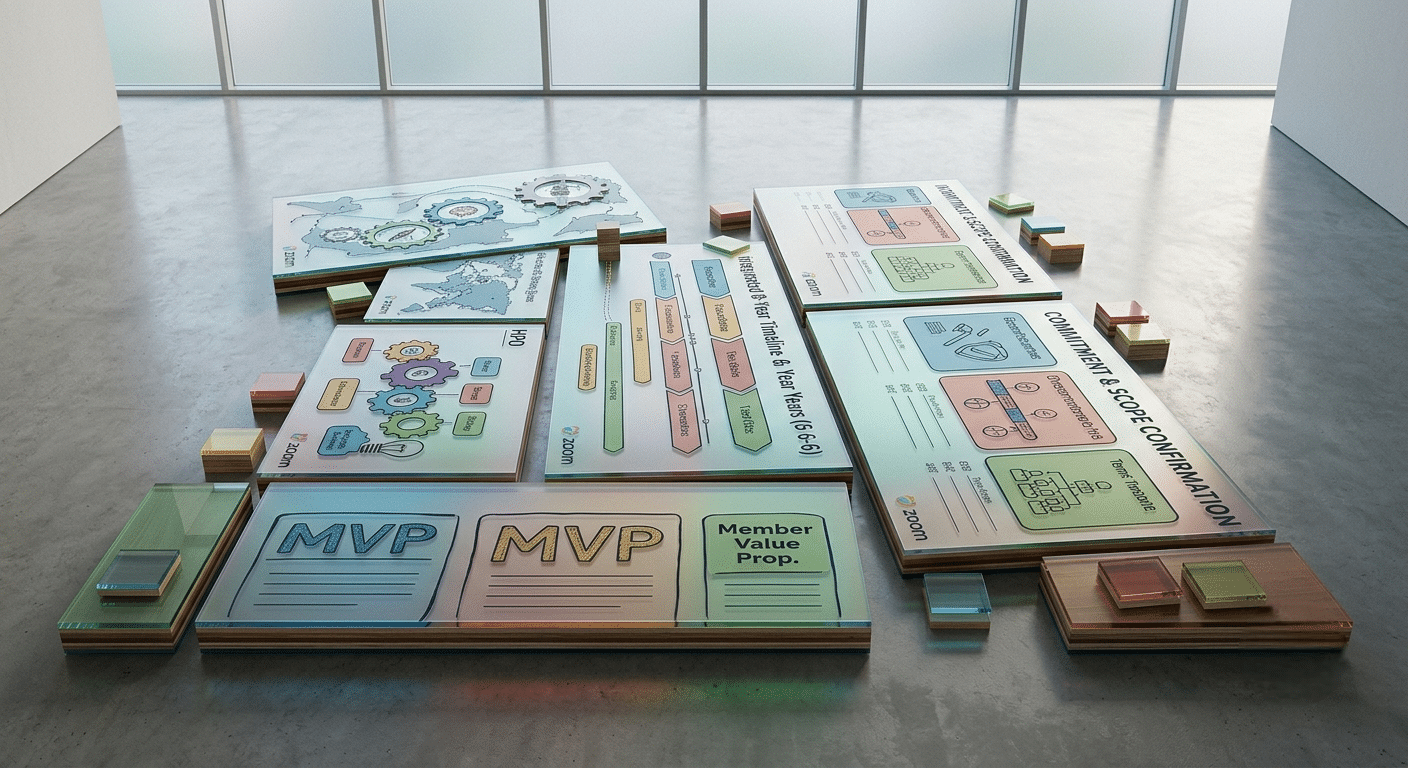
Overhead View of Large Presentation Boards Laid on a Concrete Floor, Displaying a Business Process Infographic with Gears, Flow Ribbons, and Mvp/value Proposition Panels.

What Is Not-for-Profit Strategic Planning?

Strategic planning is how a not-for-profit organization decides where it’s going in the long term, what matters most, and how to allocate its people, time, and money to get there.

Where are we now?

A clear and honest look at your opportunities, threats, and operating reality.

Where do we want to go?

Specific tactics and initiatives that will move you from your current state to your desired future state.
An implementation plan with milestones, dates, accountability, and required resources.

How will we know we’re succeeding?

Metrics, accountability, and a clear process to monitor progress.

Membership organizations serve a community, not just an organization. Zzeem’s High Performance Membership Organization (HPO™) framework helps associations create practical, actionable strategies built for high performance.

Bold White Digits '01' with a Blue Outline on a Transparent Background (step Indicator)

It aligns your board and staff.

Without a plan, every board meeting and staff meeting becomes a debate about priorities. A clear plan creates focus and reduces conflict.

the Number 02 in Bold White with a Blue Outline or Stroke (digits 0 and 2).

It builds member trust.

Members want to know you’re heading somewhere with intent. A strong plan shows direction and builds confidence.

Step 3 Label Indicating the Third Step

It attracts sponsors and partners.

Sponsors and strategic partners invest in clarity. A documented strategy signals professionalism and makes your organization a more desirable partner.
Large Digits '04' in White with a Blue Outline.

It forces honest reflection.

A good planning process surfaces the tough issues you may have been avoiding. These often include governance gaps, revenue risks, and member disengagement.

the Number 05 in Bold White with a Blue Outline on a Transparent Background.

It drives accountability.

When goals have owners and measures, good intentions turn into repeatable action.In short, a solid strategic plan can be the difference between an association that thrives and one that gradually loses relevance.

Why Strategic Planning Matters for Membership Organizations

For associations, strategic planning isn’t a “nice to have.” It’s a survival tool. Here’s why:

Circular Infographic About Strategic Planning with Six Segments: Aligns Board and Staff; Builds Trust; Attracts Sponsors; Forces Honest Reflection; Drives Accountability.

Leadership Support Program

5 Reasons Why Strategic Plans Fail: – And How to Avoid Them

When a plan fails, it happens for predictable reasons. Here are the big five:

Calendar Icon with a Checkmark.

Planning in a Vacuum

The board retreats for a day, builds a plan, and presents it to members and staff as a done deal. No input. No buy-in. No ownership.
Fix: Involve members, staff, and other stakeholders early. The people who will live with the plan need a voice in creating it. Their input will be critical, and engaging them will influence member retention.

Target Icon with a Computer Mouse Cursor.

Too Many Goals — No Real Strategy

If everything is a priority, nothing is.
Fix: Focus on 3–5 key strategic priorities.

Calculator and Document Financial Icon.

No Connection to Budget

A plan without resources is just a wish list.
Fix: Tie your financial plan directly to your strategic plan.

Abstract Geometric Letter N Corporate Logo Icon.

Overloading the Board and Staff

Make it manageable. You may need to park or deprioritize some activities to make time for new strategic initiatives. Do you have enough volunteers and staff to meet your strategic objectives?
Fix: Budget and plan for the resources you need.

Sparkling Clean Abstract Brush Stroke Icon.

The Plan Gathers Dust

An aspirational plan that never gets revisited.
Fix: Build reporting and review into your governance cycle.

The Strategic Planning Process: Step by Step

Effective not-for-profit strategic planning follows a clear, structured process. Here is Zzeem’s 9-step framework for membership organizations. This has been field-tested and proven by membership organizations of all sizes

Confirm Commitment and Scope

Before anything else, your board and leadership team need to agree on what you’re doing and why. This means:

Team of Five in a Meeting Around a Table, Reviewing a Large Project Chart Titled 'commitment & Scope Confirmation' with Notebooks and Colorful Blocks on the Table. It Shows Collaboration in a Bright Office with City Skyline Outside the Window.

Conduct an Organizational Assessment

To know where you’re going, you need to know where you are. An organizational assessment covers:

Internal strengths and weaknesses — across the 8 elements of the High Performance Membership Organization:

Six Professionals Stand Around a Conference Table, Reviewing a Large Color‑coded Project Board Filled with Sticky Notes and Labeled Sections Like Governance, Planning, Resource Mgmt, and Revenue Diversification.

Conduct an Environmental Scan

An environmental assessment scans the environment in which the association operates.

Team Presents a Large Screen Titled 'external Scan' with Opportunities and Threats Charts in a Meeting Room.

Clarify Mission, Vision, and MVP

Strategic planning is the right moment to revisit your foundational filter statements. Ask:

  • Does our mission still accurately describe what we do and who we serve?
  • Does our vision paint a compelling and aspirational picture of the future we want to see?
  • What is our Member Value Proposition?

These aren’t just marketing words. They’re the anchor for every strategic decision you’ll make. If your vision is vague or your mission is outdated, your strategic plan will be too.

Team of Five in a Boardroom Watching a Tablet Showing a Three-panel Diagram While Taking Notes in Notebooks During a Meeting, with City Skyline View Outside the Window.

Identify Pillars

Identify 2 – 3 organizational pillars — the areas where focused effort will have the greatest impact on your organization’s performance and member value. The objective for your strategic plan is to identify 1 – 2 strategic objectives for each pillar.
Common pillars for membership organizations include:

Team of Four Professionals Presenting an 'organizational Pillars' Chart with Four Stone Pillars on a Table in a Bright Office.

Build your Implementation Roadmap

For each strategic objective, identify specific, measurable milestones. Each milestone should answer:

Six Professionals Sit Around a Conference Table Studying a Large, Colorful Implementation Roadmap Sheet Laid out Before Them, in a Bright Office.

Build Your Reporting Framework

Create your reporting framework for oversight by the board and management. Your framework should include:

Four Professionals in a Conference Room Discuss a Data Chart Spread Across the Table, with Laptops and Notebooks, City Skyline Visible Through the Windows.

Communicate and Launch

Your strategic plan is infinitely more powerful with engaged buy-in from your members and stakeholders. Communicate it:

Presenter in a Gray Blazer Speaks to a Group in a Glass-walled Lobby, Attendees Hold Brochures.

Strategic Planning With Volunteer Boards

Strategic Planning With Volunteer Boards

Volunteer boards are one of the greatest strengths of the association model, and one of its greatest planning challenges.

The strength: volunteer board members bring deep industry expertise, professional networks, and genuine passion for their sector. When engaged well, they’re your most credible advocates and your most valuable strategic thinkers.

The challenge: they’re volunteers. They have full-time careers, competing priorities, and limited time. They cycle in and out of governance roles on a regular basis. And they often carry strong opinions about organizational direction without full visibility into operational realities.

Here’s how to make strategic planning work with a volunteer board:

Separate Governance From Operations

The board’s role in strategic planning is to set high-level direction and then approve the plan. The board provides input, reviews drafts, and ultimately approves the final document.

Invest in Pre-Work

Don’t walk into a board planning retreat cold. Before the session:

  • Share the organizational assessment highlights
  • Share the environmental scan highlights
  • Ask board members to reflect on a few strategic questions in advance

Boards that arrive prepared have more productive conversations and make better decisions.

Use a Skilled Facilitator

A neutral, experienced facilitator changes the dynamic in a planning session. They keep the conversation on track, surface quieter voices, manage dominant personalities, and ensure the group reaches actionable conclusions, not just interesting discussions.

Zzeem provides expert facilitation in all of our strategic planning consulting engagements. Having an outside facilitator also signals to the board that this process is being taken seriously.

Build in Accountability From Day One

Ensure your implementation plan assigns ownership for each strategic objective. Not “the board”, a specific person, or a committee/task force. And build the check-in calendar into your governance calendar.

The Role of Organizational Assessment in Strategic Planning

To build a credible strategic plan, you need to be clear on where your organization stands right now.

Bold White Digits '01' with a Blue Outline on a Transparent Background (step Indicator)

Surfaces blind spots

Every organization has areas of weakness that have been normalized or overlooked. A structured assessment brings them into the open — not as criticism, but as data.
the Number 02 in Bold White with a Blue Outline or Stroke (digits 0 and 2).

Prioritizes the planning conversation

Every organization has areas of weakness that have been normalized or overlooked. A structured assessment brings them into the open — not as criticism, but as data.
Step 3 Label Indicating the Third Step

Creates a baseline for measuring progress

If you assess your organization before you plan, you can reassess after implementation and demonstrate real improvement.

Large Digits '04' in White with a Blue Outline.

Performance

Every organization has areas of weakness that have been normalized or overlooked. A structured assessment brings them into the open — not as criticism, but as data.

The High Performance Organization (HPO™) Framework

Zzeem’s proprietary HPO™ framework evaluates membership organizations across 8 interconnected elements of organizational excellence:
Wooden Judge's Gavel Resting on a Round Sound Block on a Neutral Background

Governance

Strong governance is the foundation of a high-performing association. This element covers board structure, roles and responsibilities, decision-making processes, and the relationship between the board and management.

Open Vintage Notebook with Hand-drawn Gears and Mechanical Diagrams on a Wooden Workbench, Surrounded by Drafting Tools.

Planning

Beyond strategic planning, this element covers operational planning, annual work plans, and the integration of planning into the governance cycle.

Glowing Glass Cube Containing a Money Tree with Dollar Bills and Coins, Symbolizing Financial Growth on a Wooden Surface

Resource Management

Financial health, budget management, cash flow, reserves, and the systems that support sound financial decision-making.

Diverse Group of Coworkers Giving a High-five in a Neutral Studio, Celebrating Teamwork.

Human Resource Management

Staff and volunteer capacity, role clarity, performance management, and the culture that enables people to do their best work.
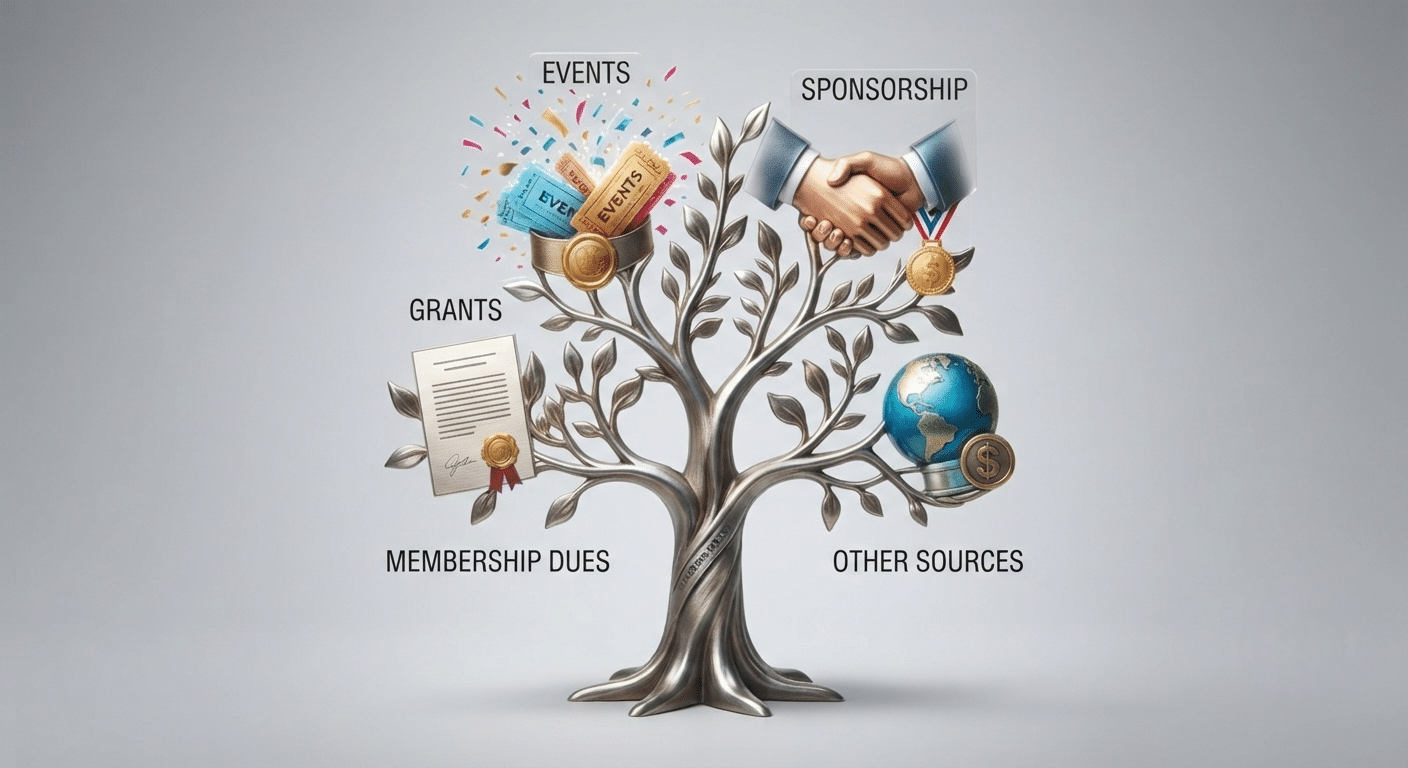
Funding Tree Illustrating Sources: Events, Sponsorship, Grants, Membership Dues, and Other Sources

Revenue Diversification

The degree to which the organization’s revenue is diversified across membership dues, events, sponsorship, grants, and other sources, reducing dependency on any single stream.

Open Metal Safe with a Handshake Symbolizing Sponsorship; Left Side Says 'sponsor'.

Member Value Proposition

The clarity and strength of the value the association delivers to its members, and how well that value is communicated and experienced.

Green Radar-screen Display on a Futuristic Control Console Showing Government, Industry Partners, Media, and Advocacy Icons for Collaboration.

Sponsor Value Proposition

The organization’s ability to attract, retain, and deliver value to sponsors and partners is a critical revenue and credibility driver for many associations.

Glass Display Cube with a Metallic Spiral and Handshake, Symbolizing a Synthesized Action Plan and Integrated Excellence (top Text).

Stakeholder Relations and Issues Management

How effectively does the association manage relationships with government, industry, media, and other stakeholders, and respond to issues and advocacy opportunities? The High Performance Transformation Program evaluates your organization across all 8 elements—highlighting strengths and identifying gaps as the foundation for every Zzeem strategic planning engagement.

What High-Performing Associations Do Differently

After more than 20 years working with membership organizations across Canada, Zzeem has identified the patterns that separate high-performing associations from those that struggle. It’s not about size. It’s not about budget. It’s about how they operate.

Here’s what the most successful associations consistently do differently:

They Treat Strategy as a Living Practice, Not a One-Time Event

High-performing associations don’t dust off their strategic plan once a year. They reference it at every board meeting. They use it to evaluate new opportunities. They report against it at least quarterly. Strategy is woven into how they govern.

They Have Ruthless Clarity About Member Value

They know exactly what their members need, what they value, and what would make them leave. They invest in understanding their membership — through surveys, conversations, and data — and they build their programs and services around that understanding. They don’t guess. They ask.

They Diversify Revenue Intentionally

High-performing associations are not dependent on membership dues alone. They have a deliberate revenue diversification strategy that includes elements such as events, sponsorships, professional development, certification, and other income streams. When one stream dips, others compensate.

They Govern With Discipline

Their boards understand the difference between governance and operations. They don’t micromanage the CEO. They don’t relitigate operational decisions. They set direction, approve policy, and hold leadership accountable — and they do it consistently, meeting after meeting, year after year.

They Invest in Professional Management

The associations that consistently outperform their peers are the ones that invest in professional support. We know affordability matters, and we know you can move further, faster by engaging professional expertise.

They Build for Sustainability

They think beyond the current board term. They build policies, systems, processes, and institutional knowledge that survive leadership transitions. They plan for succession. They maintain reserves. They build the kind of organizational infrastructure that allows them to grow and adapt over time.

Building a Living Strategic Plan

Every board meeting agenda should include a standing item: strategic plan update. Not a full review, a brief, focused check-in on progress against key goals. This keeps the plan visible and signals to the board that it matters.

Calendar and Timer Scheduling Icon.

Integrate It Into Your Governance Calendar

Every board meeting agenda should include a standing item: strategic plan update. Not a full review, a brief, focused check-in on progress against key goals. This keeps the plan visible and signals to the board that it matters.

Business Person with a Puzzle Piece Icon.

Report Quarterly Against Strategic Objectives

Develop a simple one-page dashboard that shows progress against each strategic objective. Traffic light indicators (green/yellow/red) work well. Share it in your board package. Celebrate wins. Address gaps.
Document with Clock Time

Review Annually

Once a year, conduct a formal review of the strategic plan. Ask:

  • What have we achieved?
    What’s behind schedule, and why?
  • Has anything changed in our environment that requires us to adjust our priorities?
  • Are our objectives still relevant?


This annual review is also the right time to update your operational work plan for the coming year.

Loop Icon

Refresh Every 3–5 Years

A strategic plan has a natural lifespan. After 3–5 years, the environment has changed, the organization has evolved, and it’s time to go back to the beginning — reassess, re-engage stakeholders, and build a new plan.The organizations that do this well treat the refresh not as a chore but as an opportunity. A chance to celebrate how far they’ve come, reconnect with their members, and recommit to the future they’re building together.

Profile People Icon

Use Your Plan to Drive Culture

The most powerful thing a strategic plan can do is change how people think about the organization. When staff, volunteers, and members all understand where the association is headed and why — when they can see their own contribution to that direction — something shifts. Engagement deepens. Ownership grows. The plan stops being a document and starts being a shared story.That’s what a living strategic plan looks like. And it’s what Zzeem helps membership organizations build every day.

Not-for-Profit Strategic Planning FAQ

Frequently asked questions.

Everything you need to know about working with Canada’s association management company. Still have questions? We’re here to help.
How long does the strategic planning process take for a membership organization?
For most associations, a full strategic planning process takes between 1 and 3 months from kickoff to board approval. The timing depends on the schedules of the CEO and the board. The timeline depends on the size and complexity of your organization, the availability of your board, and the depth of stakeholder engagement you want to conduct. Zzeem’s strategic consulting engagements are designed to move efficiently without cutting corners on the work that matters.
Strategic planning consulting engagements at Zzeem typically range from $5,000 to $25,000, depending on scope. The full scope includes planning, facilitation, operational assessment, environmental scan, stakeholder engagement support, plan development and the Implementation Framework. This is a sound investment — particularly when the alternative is a weak plan, or a plan that doesn’t get implemented.
You don’t need one — but you’ll almost certainly get better results with one. An experienced outside facilitator brings neutrality, process discipline, and the ability to surface difficult conversations that internal facilitators often can’t. When the executive director or a board member facilitates, they’re simultaneously trying to participate and facilitate the process. That’s a hard balance to strike.
Member engagement in strategic planning typically happens through surveys, focus groups, and open consultation sessions. A well-designed member survey can be launched, and the results documented in 3 – 4 weeks, generating valuable data on member priorities, satisfaction, and unmet needs. The key is to ask the right questions — and to close the loop by sharing what you heard and how it shaped the plan.
A strategic plan defines your organization’s direction over 3–5 years: your priorities, your milestones, and your measures of success. An operational plan translates those strategic goals into specific activities, timelines, and responsibilities for the coming year. Both are essential. The strategic plan without an operational plan stays abstract. The operational plan without a strategic plan loses direction.

Four things:

  • Ensure you have an implementation plan,
  • Ensure you have measures of success (KPIs),
  • Report against it at least quarterly, and
  • Do an in-depth review of it annually.

The organizations that keep their plans alive are the ones that treat them as management tools, not ceremonial documents. A simple one-page dashboard reviewed at every board meeting is more powerful than a beautifully designed 40-page booklet that no one opens.

Absolutely. Many of Zzeem’s strategic consulting engagements start with an existing plan that has stalled. We help you assess what’s working and what isn’t, identify the root causes, and help you either revitalize the existing plan or build a new one on a stronger foundation. If your plan is gathering dust, that’s a solvable problem.

Ready to Build a Strategic Plan That Actually Works?

Zzeem has been helping membership organizations across Canada build high-performing associations for over 20 years. Our strategic planning engagements are designed specifically for associations — not adapted from corporate frameworks, but built from the ground up for the unique dynamics of membership organizations, volunteer boards, and the communities they serve.

Whether you’re starting your first strategic plan, refreshing an existing one, or trying to revive a plan that’s lost momentum, we can help.

Here’s what working with Zzeem looks like:

1

A structured, facilitated process that respects your board’s time and capacity

2

Our proprietary High Performance Transformation Program assessment as your foundation<

3

Experienced consultants who understand the association management landscape across Canada

4

A plan you’ll actually use — with the accountability structures to keep it alive

Your next step is simple.

Contact Zzeem to schedule a conversation about your organization’s strategic planning needs. No obligation. Just a straightforward discussion about where you are, where you want to go, and how we can help you get there.